Sunday, March 13, 2011

Saturday, December 19, 2009
Podcast Appalachia 12: "Appalachian Christmas"
It's a special Christmas edition of Podcast Appalachia, featuring Christmas memories and stories from the Appalachian region! You can listen here.
Wednesday, December 02, 2009
Podcast Appalachia: "Moonshine"
Remember the Snail Darter!
Longtime East Tennessee residents probably remember the controversial Tellico Dam, built by the TVA during the 1970s as a means of bringing economic development to Loudon County and the Tennessee Valley. This was the first--and only--TVA dam built for this reason; those previously constructed were for flood control.
The Tellico Dam is probably best remembered today, and least outside the Tennessee Valley, as being nearly torpedoed by the infamous snail darter, a small fish whose habitat was said to be threatened by construction. The snail darter would delay construction for several years, and became a symbol of dogmatic environmentalists standing in the way of progress.
Small fish weren't the only obstacles to construction, however. Native Americans argued that the land flooded held religious significance, and environmental groups questioned the ethics of radically changing the Little Tennessee River, especially for the sole purpose of possible economic development. They too fought the good fight, but only succeeded in delaying the inevitable. The Native Americans fought the White man and lost, a recurrent theme of American history.
Then there were the property owners themselves, whose land was slated to be flooded. Since politicians rarely ever care much about the little guys who get in the way of their master plans, these people were kindly informed they would have to leave, and generously offered money for their troubles. This was done under the guise of eminent domain, and surely would have made supporters of the Kelo vs. New London decision proud.
Some of the property owners sold willingly; others held out to the bitter end. The most famous holdout was Nellie McCall, an elderly woman who had lived in the area her whole life, and who became a powerful symbol for the holdouts. She refused to sell out and refused to budge, but was eventually evicted by federal marshals.
Though the critics lost that battle, they may have eventually won the war: prior to the controversy, few questioned the construction of new dams, seeing them as progress, a sign of technological advancement and an enlightened society. Those who stood up to the TVA helped change this perception (it's hard to win a PR battle while forcibly removing poor, elderly women from their homes), and no TVA dams have been built in the three decades since.
WBIR notes that it was been 30 years since the Tellico Dam opened its gates on the Little Tennessee River, and features some remarks from a man who initially opposed its construction and lost some property as a result, but has since come around to accept the dam as an advantage for the region. Perhaps he's right, but I'm not so sure.
Cross-posted at Appalachian Abroad
Tuesday, November 03, 2009
Podcast Appalachia is Back!
Wednesday, April 01, 2009
NPR on MTM
All Things Considered ran another story yesterday afternoon on Mountaintop Removal Mining and the administration's recent moves against it, including this bit: "There is no practice in this country as environmentally destructive as large-scale surface mining."
Read and listen here. Kudos to NPR for its long-time attention to this issue.
A few helpful links:
Wikipedia
ilovemountains.org
Mountain Justice
Appalachian Voices
stopmountaintopremoval.org
Some great (horrific) photos
Wednesday, March 25, 2009
EPA puts the skids on Mountaintop Removal
 In news that is sure to be met with glee for most readers of this blog, the Environmental Protection Agency yesterday announced it was reviewing the permit process for Mountaintop Removal Mining Projects in the Appalachian Region.
Citing its authority under the Clean Water Act, The EPA sent two letters to the Army Corp of Engineers expressing water quality concerns specifically regarding two MTM projects, one in Kentucky, and one in West Virginia.
In short, it's going to get a whole lot harder to start up a new Mountaintop Removal Mining Operation under this administration.
Read more here and here, and the EPA's official release here. Local angle here.
Thursday, February 19, 2009
Now & Then winter issue celebrates ‘Fabric of Appalachia’

Now & Then winter issue celebrates ‘Fabric of Appalachia’ |
| Tuesday, February 03, 2009 |
JOHNSON CITY – The fall/winter issue of Now & Then: The Appalachian Magazine, themed “Fabric of Appalachia,” looks at fabric in both literal and metaphorical contexts. Published by the Center for Appalachian Studies and Services at East Tennessee State University, the magazine celebrates its 25th anniversary this year. The publication regularly brings together some of the best contemporary Appalachian writers and poets, and the now-available “Fabric” issue is no exception. In a literal sense, fabric is explored from a variety of viewpoints. Famed North Carolina quilter, author and businesswoman Georgia Bonesteel contributes an article entitled “Appalachian Quilting.” She is best known for her nationally broadcast PBS series “Lap Quilting with Georgia Bonesteel.” Nancy Jane Earnest gives an account of the L.C. King Manufacturing Co. of Bristol in “Still Sewing the Fabric of Appalachia,” and author Michael Joslin goes to the source in “A New Face in the Fields: Alpacas in Appalachia,” visiting Apple Hill Farm in Watauga County, N.C. In “From Quilts to Chenille Bedspreads to Carpets,” Lydia Knight explores the rise of the fabric industry in Dalton, Ga. Now & Then Editor Fred Sauceman tells of the Southern Garment Corp. in Greeneville during and after World War II, then adds a recipe for spaghetti sauce with meat to the mix. Other contributors approach fabric metaphorically. Elizabeth Hunter, a freelance writer living in the Bandana Community in Mitchell County, N.C., contributes a community-building piece entitled “The Great Bandana Porch Sit.” And Matthew Schacht focuses on non-profits that work with prisoners and their families in “Freeing Families: Non-Profits in Northeast Tennessee Help Families Fight Cycle of Recidivism.” Marat Moore introduces readers to “Chest-messaging in the Coalfields: A Look Back at the T-Shirts of the Pittston Strike,” author and poet Jeff Mann contributes “Here and Queer,” while Grace Marshall writes about Wise County, Va., native – and cousin to George C. Scott – Gary Slemp in “Appalachia’s Renaissance Man,” and M. Thomas Inge describes a detective’s journey in “Searching for Sut: Solving the Mystery of George Washington Harris’s Gravesite.” The “Fabric of Appalachia” issue is interwoven with short stories by Rosanne Griffeth, Jeff Kerr and Randy Sanders; first-person narratives from Judy Lee Green and Dan Jones; book and music reviews; and poems from five regional poets. The magazine is available in Johnson City at Barnes & Noble Booksellers, The Shamrock on W. Walnut Street, and ETSU’s University Bookstore and Reece Museum. It is also sold at the Historic Jonesborough Visitors Center; the ETSU and General Shale Brick Natural History Museum and Visitor Center at the Gray Fossil Site; Wallace News and Bays Mountain Park, Kingsport; Jacklyn’s Hallmark, Elizabethton; William King Regional Arts Center and Zazzy’s, Abingdon, Va.; and Downtown Books and News, Asheville, N.C. To subscribe online, visit www.etsustore.com, or order by phone by calling (423) 439-7994. For more information, call 439-7865. |
Friday, January 30, 2009
Appalachian Witches haunt Alabama audiences
If you're in the Huntsville, AL area you'll want to get yourself on over to Burritt on the Mountain this weekend. A brand new play titled "Appalachian Witches," by Christine Burke Ashwell wraps up its premiere run this weekend. It's the story of three women bound to the Appalachian Mountains, its traditions and music, superstitions and ghosts, history and faith. One family's bloodline speaks in the joyful voices of the mountains with a capella songs, stories and legends presented in a light-hearted storyteller style. Tanja Miller, left, and Criss Ashwell appear behind Karen Lynn in "Appalachian Witches."
Ms. Ashwell has served as Alabama's state chairperson for community theatre under the Alabama Conference of Theatre, and as Alabama State Representative to the American Association of Community Theatre from 2001-2007.
Dave Tabler caught up with her this week to get a peek at what's in store for audiences:
DAVE TABLER: Why did you write this play?
CHRISTINE BURKE ASHWELL: I suppose I see a lot of culture getting lost in development throughout the Appalachians, or just the progression of time. I certainly think that we have lost a lot of connection with the land, natural remedies and healing arts. I think the stories told throughout the mountains are allegorical as well as historical and funny and sad and so very valuable to the history of a resilient and vastly diverse population who resided in the hills of Appalachia.
So I'm creating a few more stories, reminiscent of theirs and incorporating history and culture to appeal to a modern audience. Moreover, I think my grandfather said it best, "Being poor does not mean living poorly." In fact, as hard as some families had it, there was often more riches to be found in the people themselves than money could ever buy.
DT: What was one of your biggest challenges in pulling this play together?
CBA: The one thing that I hesitated with is the dialect. Even being from the area I have a difficulty understanding some folks in the mountains. We have strived for the voices to be the natural sounds of the mountains in a dialect and accent that are not stereotypical or affected, but can be generally understood by most theatre audiences.
DT: What are some of the influences you drew on for this piece?
CBA: Hmm, a lot of absorption of reading everything from the backs of herbal tea boxes to Lee Smith's books to Pilgrim at Tinker Creek to –my favorite--the Foxfire books. Or listening to the tour guides recite their scripts--yes, there are those of us who listen! In addition, I LOVE picking up those little self published booklets that you'll find in the gift shops of MANY places around the hills or rest stops.
Many times, I don't buy them, I just browse them right there in the store. Somehow, something sticks in the back of my brain until I start on something, talking about history or superstitions. I don't have a photographic memory or anything as grand as that, but those little books have proven quite entertaining, and rather informative of how life was for that family in that community.
One place that I will credit, too is the Hillbilly Savants blog. They had a great article on an earthquake and I did incorporate that into the show with a story of a meeting with the devil and some old demon exorcism goodies from the Bible.
I am ambiguous about time in the play: there are still quakes and such these days (one last year right here in Alabama) on the fault line that made these mountains.
DT: Where in Appalachia is the play set?
CBA: I wrote the play to be ambiguous in the locale. The mountains are so wide and diverse, one hill to the next is different, much less Georgia mountains to Tennessee to Virginia to Pennsylvania. I took a little from each place and created a few of my own "legends". The show is presented in a storyteller style so it's pretty audience friendly with very simple staging and production. I was also a little ambiguous on the language. At times, I cannot understand a word from the folks in the hills--whether from Virginia or Georgia.... Or my own family! But we've tried to remain true to mountain sounds, still remaining understandable by general audiences without being caricatures or stereotypes. DT: Does the play take a religious moral stance?
CBA: You can't tell the stories of the mountains without including a big dose of God and His affect on the lives of the people of the mountains. Many healers quoted the Bible for their powers to stop blood or draw out fire. Faith and church was a source of comfort, support and hope in difficult times and a joyous gathering place when times were good. Going to meeting was source of news and certainly gave the spread-out lonesome hills a sense of community. I never wrote the show intending to have such a strong dose of religion or any sort of message or morality play. God is simply an everyday presence, and religion a way of life, for these characters. These are joyful souls.
DT: The show's music is entirely a cappella. Why that choice?
CBA: Singing the songs a capella lend the production towards what I consider an honest and true voice that should be uncaring of whether there is perfect pitch or not. The voices are REAL voices that sing hymns next to you in church or sing when working around the house. The religious songs are reminiscent of songs you've heard in church.
Camp meetings were a constant gathering place in the hills and songs traveled as much as the preachers. The first song is a mountain story song, passing the news of a local event. The next is a lullaby, sung to comfort a boy and pray for healing. The song that ends the first act is a toe-tapping hymn to encourage faith and hope.
The second act contains another spiritual calling sinners to God before it's too late. Then there's a mountain story-song of Ma Mary and the tragedy that befell her and her children. The play ends with the chorus of a traditional hymn that reminds Kate of her grandmother.
"Appalachian Witches" runs January 30 and 31 at 7:30 p.m. Admission is $15 per person and groups of 12 and more are $12 each. Tickets are available at 536-2882 or www.burrittonthemountain.com. At the Old Country Church at Burritt.
Sunday, December 21, 2008
Appy-Love

I'd like to direct your attention to another great blog focused on our fair region. Appy-Love is a relatively new project, and is coming along quite nicely. The author has some good stuff that's worth your attention. If nothing else right now, you've got to check out her first post from back in November:
Appy Love might become a source of ideas to get you out of your house and into Appalachia. I'd like to spend some time visiting, researching, and writing about the hills, hollers and holes-in-the-wall that have been surrounding me all this time, but that I've occasionally eschewed in favor of big cities (Atlanta and London) or big box retailers (Target and Old Navy). As they say, with age comes wisdom. Or at least the determination not to be a complete jackass. Since I live in Johnson City, posts will start here and radiate as far outward as gas prices will allow. Here goes nothing.Keep reading.
Sunday, October 26, 2008
Great Smoky Mountains National Park turns 75
 Clay Owen
The 75th anniversary of the opening of the Great Smoky Mountains National Park is soon approaching. The most-visited park in the entire National Park system, the GSMNP is celebrating in the coming year with a series of events featuring Dolly Parton as the park's official Ambassador.
Scott Barker has an excellent piece in today's Knoxville News Sentinel surveying many aspects of the Park.
Sunday, October 12, 2008
The Museum of Appalachia's Tennessee Fall Homecoming

The Museum of Appalachia's Tennessee Fall Homecoming is one of the finest and most-important events each year in all of Appalachia. We spent a couple of days at the museum in Clinton, TN this weekend.
 David Baker of Sevierville, TN mans his family's apple press and sells mountain taffy.
 Okra dries in the October sun.
 Ronda Vincent and the Rage entertains thousands at the Museum's main stage. This year's homecoming featured five stages of continuously-running music.

 Above are two pieces featured in the museum's massive Display Barn. The museum's collection is absolutely huge, as well as incredibly varied. Items range from the former property of some of the most prominent figures in Appalachia's history, to simple items upon which the people of the region relied on that were crucial to their survival.
 The WDVX camper, the station's original studio.
 Museum founder John Rice Irwin chats with old-time fiddler Charlie Acuff (cousin to the late Roy Acuff, King of Country music).


 Many of the museum's most-impressive items are on display in the Appalachian Hall of Fame. John Rice Irwin's personal touch is evident throughout the grounds of the museum, but especially in this building. Most of the placards are personally inscribed by Mr. Irwin, and his first-person accounting of the acquisition of many of the items are as rich as the artifacts themselves.
More photos from the weekend are here.
Wednesday, October 08, 2008
Images from Middle Tennessee
So the western part of middle Tennessee would be considered only barely on the fringes of Appalachia by any definition, however I thought I'd share these photos of home that I took last time I made it down. Anyway, isn't Appalachia more a state of mind than an actual geographic boundary? Okay, maybe it is an actual geographic boundary, but that's beside the point.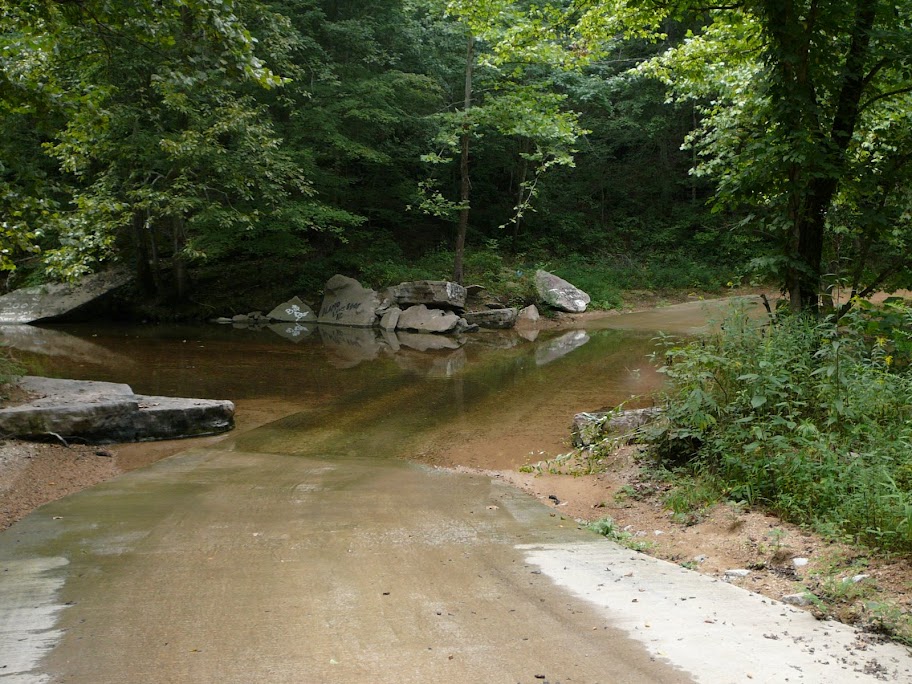


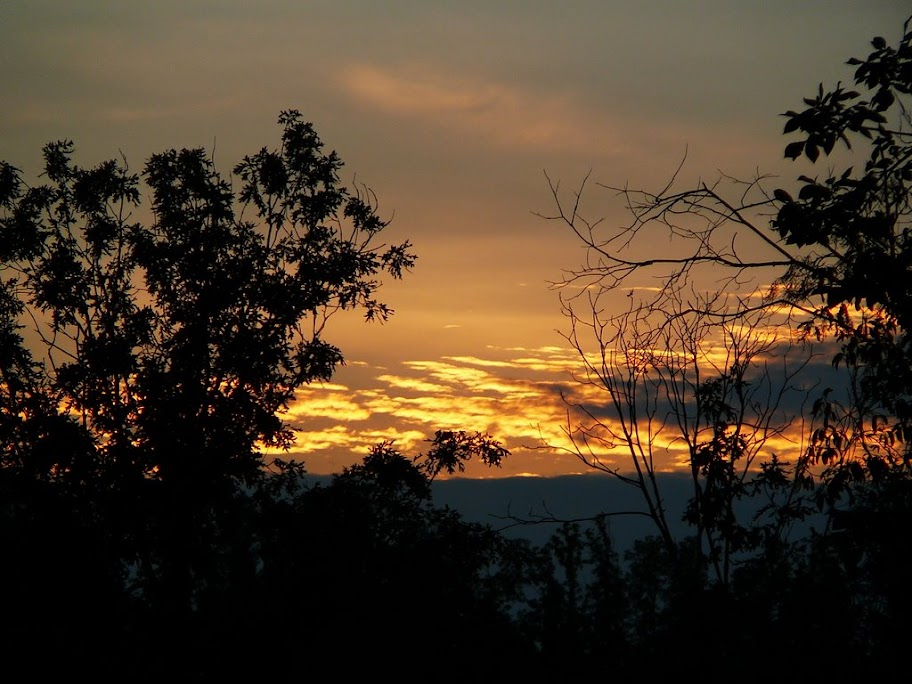
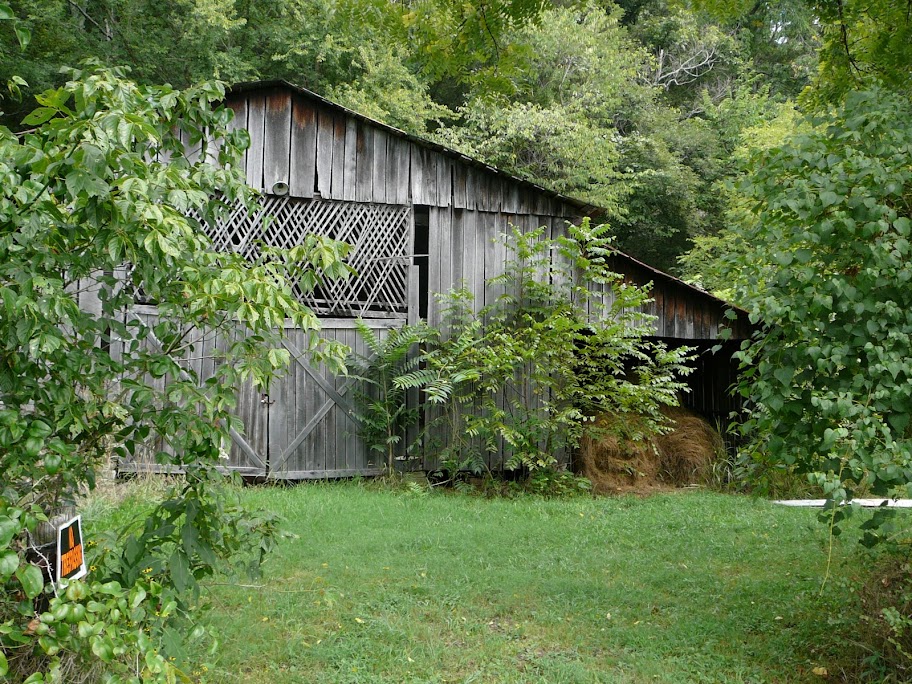 The rest of my photographs can be found on my PicasaWeb site.
Wednesday, September 17, 2008
Pucker up, it's persimmon time in Tennessee!
 While driving to church yesterday morning, I spotted my first sign that fall was here. Lying in the middle of the road was an old familiar sight. Dozens of little orange berries, some smashed, some round and waiting to be run over. When I was a kid growing up here in East, TN, persimmons brought both pleasure and aggravation to my life.
According to Wikipedia, the American Persimmon tree grows mainly in the Southeastern United States. Its ranges from New England to Florida, and west to Texas, Oklahoma, and Kansas. The tree grows wild but has been cultivated for its fruit and wood since prehistoric times by Native Americans.
I know that persimmon trees can be found in  nearly every yard here in Knox County. In my own yard, I have only male persimmon trees, which do not bear any fruit. My parents, however, have female persimmon trees in their yard. My, the memories those things hold for me. From my earliest recollections, folks have been tricking younger kids into sampling green persimmons. I can remember my cousin Danny saying; “Oh, Tug, these persimmons are delicious, you’ve got to try one!” Then he held one up to his mouth and pretended to take a bite and acted like it was the best thing he had ever tasted in his life. Of course I, not wanting to look stupid in front of my hero cousin, took a big bite. If you have never bitten into a green persimmon before, you don’t know what you are missing. Or rather I should say you don’t want to know what you are missing! It takes no more than one bite into one to turn your mouth completely inside out. It has the similar
  effect of biting into a lemon, only worse! The first thing you want to do after trying one is to stick your tongue out and start slapping it. That is hard to do because your lips are now drawn into a frozen pucker, making this nearly impossible.
I can’t even tell you the number of folks that I played the above trick on. I know I did it to my younger sister, brother, and cousin Brad. Of course I also tricked my younger brother into sampling worms (which I wrote about in THIS post), bugs, and dandelions, but I’ll save those stories for another day. Ah the pleasures of being an older brother…
Persimmons brought a mixture of joy and misery into my life. Once the fruit gets ripe; it falls off of  the tree. Naturally, this leads to the ground below being covered with plump, juicy, and sticky orange balls. I don’t know if you have ever slipped down into a slimy pile of persimmons, but let me tell you that is one nasty mess! Also much like “manure wars” we had persimmon wars. The green ones hurt, but the ripe orange ones would explode on your body and make a gross mess on your clothes, or in the worst case…your hair. I can still see my sisters and me running barefooted through the yard, slipping in persimmons, slinging them at each other, falling down and getting leaves and dirt matted into our clothes. My granny Spencer also had numerous persimmon trees in her yard and every time we went to her house we would get into them. Usually we would have a war with Becky, Paula, and Jeff Lawson, all whom lived next door to granny. The only thing separating us was a white wooden fence and a driveway. We would sling those persimmons with all of our might at each other, like it was a life or death situation. Oh what fun!
 Some people eat persimmons and make things like pies and pudding out of them. I’ve eaten a few ripe ones and they are pretty good but the consistency of the fruit kind of turns me off. They are mushy and slimy, two textures that really don’t agree with my palate.
I came across this website: PersimmonPudding.com, which has lots of good information and stories about persimmons. Check it out when you have time.
The above is a cross post from my Tug's Life blog.
Saturday, August 30, 2008
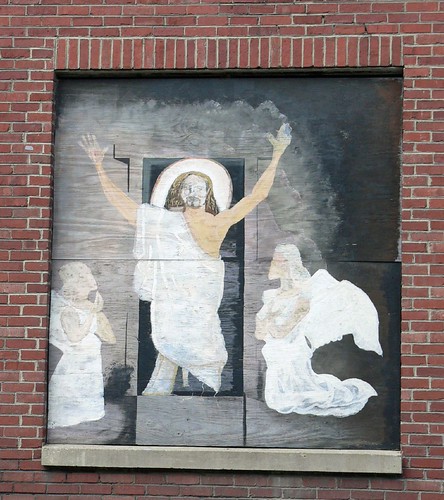
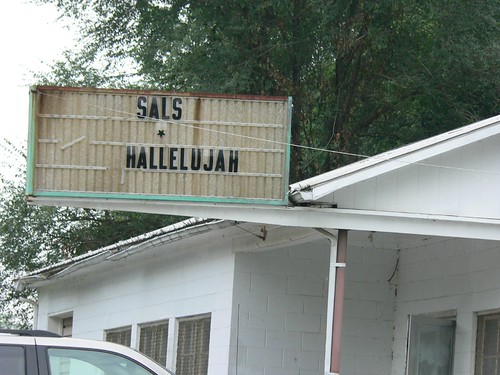
Religious signs in West Virginia
Some religious signs from a recent highly bumpercropulous swing through southeastern West Virginia.
There was a great, raucous Holiness service going on in this church, and the doors were open, so I parked and listened. Some folks came out of the church and invited in. I wish I could have joined them, but I had a dog in the car with me and couldn't leave him.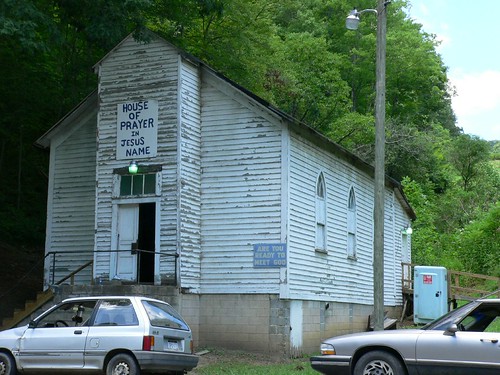
On the same church: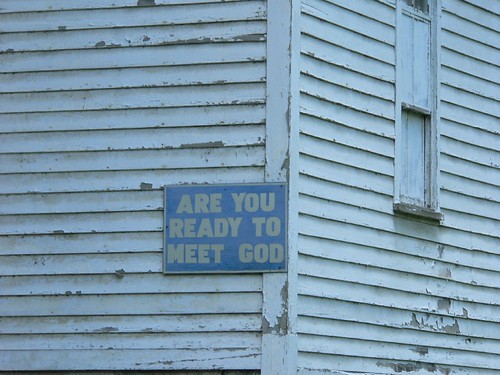
Near that church: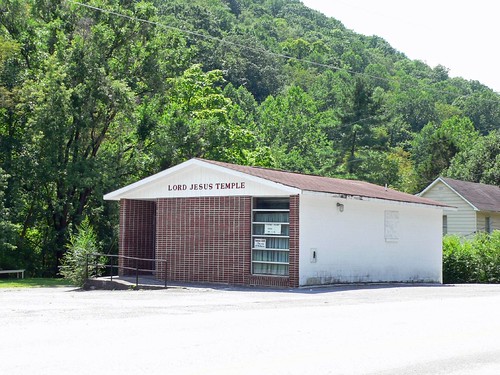
Also in McDowell County: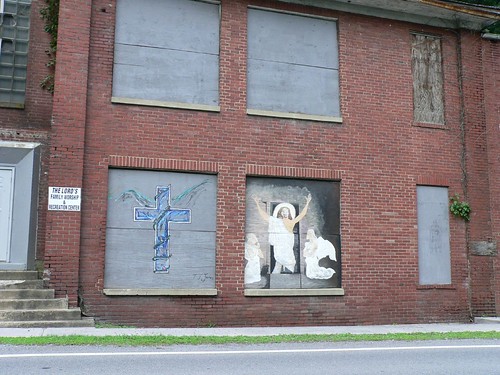
Close-ups of the Jesus windows. The Roman soldier drawing blows me away--what a peculiar choice.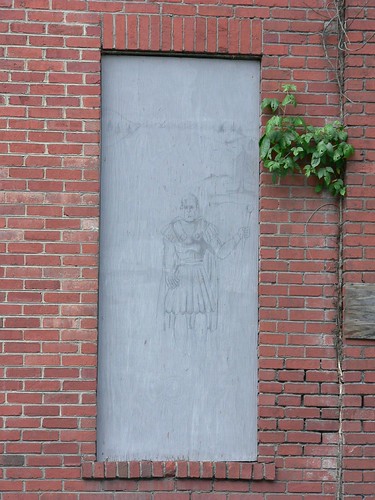

Fayette County: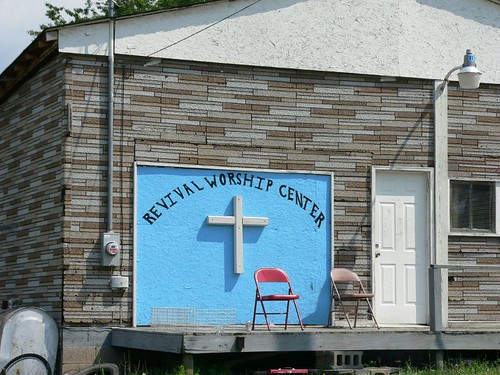
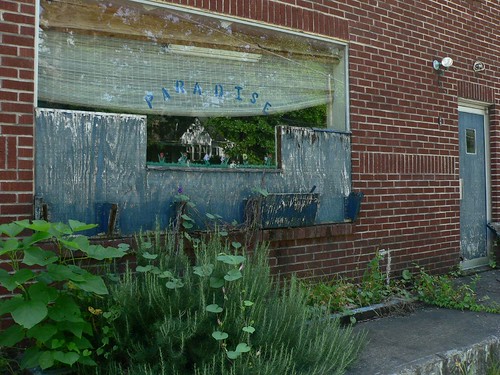
Close-up:

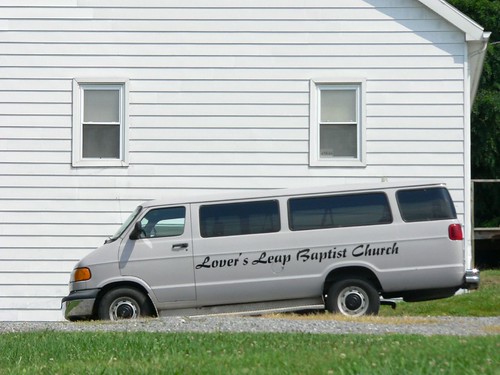
In Kincaid, a combination post office-praise center.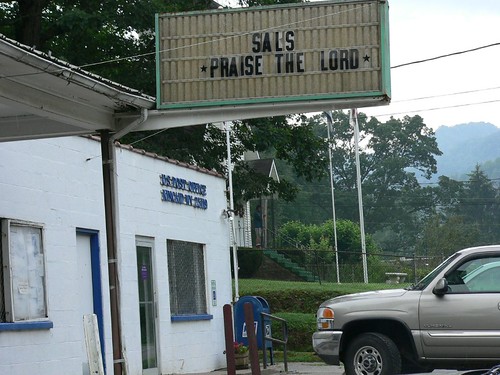
Hard to read, but the little blue sign says "Christians helping others."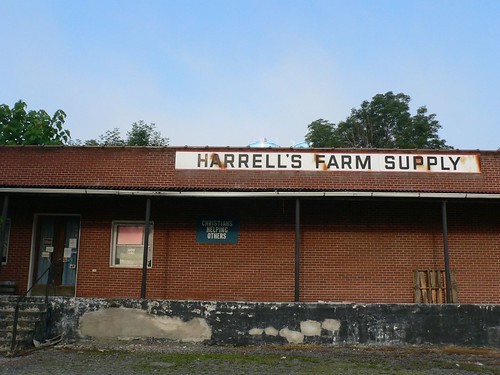
Hico: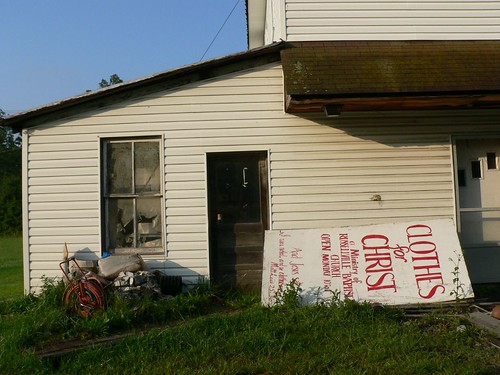
From the Field Guide to What's Good.
Subscribe to:
Posts (Atom)